Un moteur qui anticipe. Une passerelle qui agit.
Deux couches coordonnées pour l'orchestration de puissance en boucle fermée du rack IA.
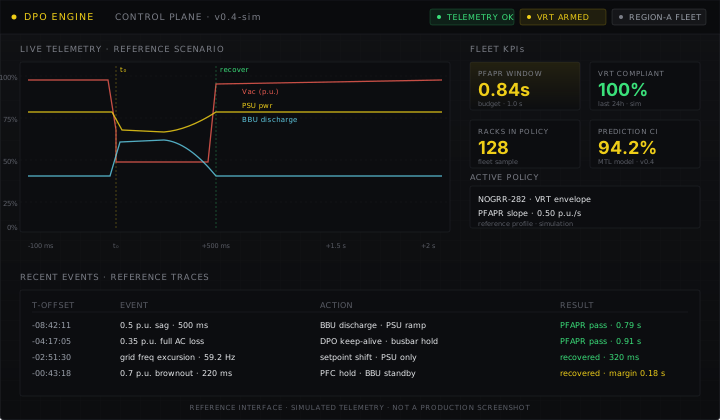
Rack-level control layer that forecasts GPU load ahead of the transient and computes setpoints for the power shelf. Runs as a software process alongside the workload scheduler.
INTERFACES
- Redfish API — telemetry ingestion
- PMBus — power shelf control
- OCP ORv3 PMI — rack coordination
Target: OCP certification 2027 Q4

Rack-mounted hardware node that coordinates BBU discharge and PSU output inside the ORv3 power shelf. Designed as a pin-compatible replacement for the PMI module.
INTERFACES
- OCP ORv3 PMI-compatible form factor
- SMBus + PMBus control
- Real-time BBU + PSU coordination
Target: UL safety certification 2027 Q4
BOUCLE DE CONTRÔLE
Comment DPO répond
ARCHITECTURE
Prévoir, orchestrer, se conformer.
DPO sits between the data center EMS and the ORv3 rack. The diagram below shows the DPO Gateway Specification — XMight's open contribution to OCP Rack & Power — and the closed-loop architecture our commercial DPO implements.
Conçu pour les racks ORv3 / ORW visant les déploiements NVIDIA Blackwell-class (GB200 NVL72 et architectures successives). Le matériel DPO Gateway est aligné à la fois sur le standard rack OCP Diablo 400 ±400 VDC et sur l'architecture NVIDIA 800 VDC MGX (Huntington & Tu, 2025) — selon le modèle de compatibilité double-entrée présenté dans la Figure 9 du whitepaper public NVIDIA. La coordination BBU de DPO est calibrée sur l'enveloppe 120 kW de la génération Blackwell, avec une compatibilité ascendante vers la classe rack 400 kW – 1 MW+ définie par OCP Diablo 400.
L'alimentation ORv3 classique réserve 20–30% de marge pour l'absorption des transitoires — une capacité de calcul définitivement bloquée. DPO réduit cette marge à 5–10% grâce à la prédiction des transitoires à l'échelle de la milliseconde et à la décharge BBU coordonnée. Le throttling n'est pas éliminé ; il devient plus petit, plus intelligent, et continu.
Source: ORv3 Base Specification headroom reservation values; DPO target band based on closed-loop simulation across reference workload mixes.
RÉPONSE AUX ÉVÉNEMENTS DE TENSION
Comment un rack ORv3 réagit — avec et sans DPO.
Deux scénarios d'événements de tension, quatre traces chacun. Colonne gauche : alimentation ORv3 conventionnelle. Colonne droite : même scénario avec DPO coordonnant la décharge BBU et la sortie PSU.
Sans DPO, le PFC se déclenche en quelques millisecondes et le redémarrage du PSU prend 6–17 secondes — bien au-delà du budget PFAPR de 2 secondes. Avec DPO, le moteur prédit le transitoire, la passerelle coordonne la décharge BBU pour maintenir le bus 48V, et le PSU se rétablit selon une pente conforme au PFAPR. Même matériel, plan de contrôle défini par logiciel.
Les scénarios 2 et 4 (excursion de fréquence et brownout) sont détaillés dans la DPO Gateway Specification.
FLUX D'ÉNERGIE
Du transitoire GPU à la charge visible par le réseau.
DPO intercepte le transitoire avant qu'il ne se propage au point de couplage réseau.
ANALYSE INDUSTRIELLE
Quatre lacunes que le contrôle en boucle fermée doit traiter.
Mapped against current OCP ORv3 specifications. Each gap belongs to a different leaf-spec owner — none can be closed by a single vendor or a single spec change. DPO addresses all four at rack level.
PSU PFC low-voltage behaviour
ORv3 PSU operates 180–305 V AC; specification permits derating between 180–198 V. Below 180 V (~0.75 p.u.), PFC shuts off in approximately 20 ms with 20 ms holdup. NOGRR 282 §2.14 requires ride-through to 0 p.u.
PSU controller power-on delay
PSU controller loses power on AC drop; cold-boot on restart introduces a 0–15 second random delay for inrush staggering. The PFAPR budget is 1 second — current behaviour fails by 5–17×.
BBU trigger condition
BBU Module 1.4 §4.5 specifies discharge trigger at busbar < 48.5 V for 2 ms. This covers full AC loss but does not provide coordinated voltage-sag support.
PMI interface scope
PMI Specification 1.0 §2 defines pass-through monitoring only. No write commands, no open rack-level read-write coordination path is currently defined.
DPO Engine + DPO Gateway sont conçus pour combler les quatre lacunes au niveau du rack, sans nécessiter de coordination avec les fournisseurs de composants.
INTÉGRATION OCP
DPO Gateway est compatible OCP ORv3 PMI.
We identified 12 modifications required across 7 OCP spec documents for ERCOT compliance — the gap between ORv3's current disconnect-on-fault behavior and grid ride-through requirements. DPO Gateway extends PMI Specification 1.0 to enable dynamic power orchestration at the shelf level.
| Spécification | Version | Exigence ERCOT | Statut |
|---|---|---|---|
| Open Rack V3 Base | 1.0 | VRTFRT |
Gap identified |
| Power Shelf | 1.0 | VRTPFAPR |
Gap identified |
| 48V PSU | 1.0 | VRTPFAPRFRT |
Gap identified |
| PMI | 1.0 | VRTPFAPR |
DPO extends |
| BBU Shelf | 1.1 | VRTPFAPR |
Gap identified |
| BBU Module | 1.4 | VRTPFAPR |
Gap identified |
| Modbus Register Map | 0.73 | PFAPR |
Under review |
The Active BBU: Dynamic Power Orchestration for Stable and Efficient ORv3 AI Racks
Présenté à l'OCP Global Summit 2025
This paper describes the Active BBU architecture — the technical foundation of DPO — and its role in enabling PFAPR compliance while reclaiming compute headroom traditionally reserved for transient buffering.